Kenya's Stadium in the Slum: A Study in Misplaced Grandeur
Kenya is building a Sh45.85 billion (about US$353 million) stadium on the edge of Kibera. The lights will be very bright, bright enough to hide what lies behind them.
By Joseph A. Sampson · · 8 min read
A note before I begin: this piece was inspired by a friend who works on the construction site of this very stadium, where she is paid about eight dollars a day. She is likely to disagree with much of what I have written here.
All misplaced priorities announce themselves in the same way: first as progress, then as scandal, then as the normal order of things.
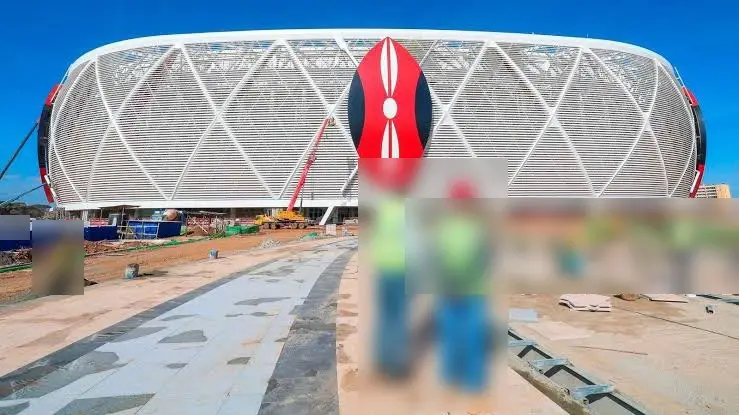
Stand on Ngong Road after dark and you can watch the first stage happen. At Jamhuri Grounds, in Nairobi's Kibra Constituency, a 60,000-seat stadium rises above the traffic, its roof ringed in light, its lit facade glowing for the cameras. It began life as Talanta Sports City. Talanta is Swahili for talent. When it opens on January 5, 2027, it will carry a new name: the Raila Odinga International Stadium, after the late former Prime Minister who represented this corner of Nairobi in Parliament for more than twenty years.
On paper, it costs 45.85 billion Kenya shillings (Sh45.85 billion, about US$353 million). The National Treasury approved Sh35 billion (about US$269 million), to be drawn from the Sports and Arts Social Development Fund over six years. The Auditor-General, Nancy Gathungu, examined the gap and called it what the documents showed it to be: "an unsupported price variation of Sh10.85 billion (about US$83 million)." Her report found that the contract was awarded by direct procurement, a method that "did not meet competitive procurement and direct procurement criteria" under the law, and that the Attorney-General's clearance, which the law requires for any contract above Sh5 billion (about US$38 million), "was not provided for audit." The government says the clearance was obtained. The Auditor-General says the details of the funding model were not provided to her auditors at all, and that only a special audit can tell Kenyans whether they are getting value for their money.
The money itself was raised in July 2025 through a 15-year asset-backed security of Sh44.79 billion (about US$345 million), listed on the Nairobi Securities Exchange at a return of 15.04 per cent a year. It is to be repaid from the Sports Fund, whose income comes largely from taxes on gambling and betting. Kiharu Member of Parliament (MP) Ndindi Nyoro says the fund must remit Sh500 million (about US$3.8 million) a month for 15 years, and that interest of about Sh100 billion (about US$770 million) will take the real cost to Sh145 billion (about US$1.12 billion). The government has published no repayment schedule that would settle the argument either way.
The builder is China Road and Bridge Corporation, chosen without competition. The procuring entity is not Sports Kenya, the agency that manages the nation's stadia. Its Director General, Timothy Kilimo, told MPs in March: "We did not have a role in procurement. We are not the procuring entity for Talanta Stadium." The procuring entity is the Ministry of Defence, with the Kenya Defence Forces supervising the work. In Kenya, when a civilian project wants to avoid civilian questions, it puts on a military uniform.
There is a bitter symmetry in that. Kibera itself began in 1904 on the exercise grounds of the King's African Rifles, as land handed to Nubian soldiers returning from colonial service. More than a century later, the military is back beside Kibera, this time pouring concrete for a stadium instead of granting plots for homes.
On January 5, the gates will open for a friendly match between Bayern Munich and Ajax Amsterdam. German reports say Bayern alone will receive five million euros, about Sh724 million (US$5.6 million); what Ajax will receive has not been disclosed. The activist Boniface Mwangi estimated the fees at Sh250 million to Sh300 million (about US$1.9 million to US$2.3 million) per club, before flights, hotels and security. The Sports Principal Secretary, Elijah Mwangi, insists that "the government of Kenya have not contributed" and that unnamed "strategic partners" are paying. Yet no sponsor has been named, no budget has been published, and citizens have gone to court at Milimani to force the disclosure. Boniface Mwangi put the objection plainly: "Ruto wants to pay foreign teams to play at our stadium while inviting our own football stars and aspiring players to sit as spectators." The month before, he noted, the national team, Harambee Stars, had gone on strike over unpaid allowances of about Sh80,000 (US$615) per player.
And that brings us to the point that cannot be politely avoided.
Talanta sits on the edge of Kibera.
Kibera is not a slum in the way Nairobi likes to say slum, a word that makes poverty sound technical and romantic. Kibera is a hillside of rusted iron roofs, pressed so tightly together that from the air they look like a single corroded sheet, spread across roughly 2.5 square kilometres by the usual estimate. The 2019 census counted about 185,000 people in Kibra Constituency; residents and aid groups have long put Kibera's own number far higher. That no one can agree on how many human beings live there is itself a verdict. Most live without title, without sewers and without reliable piped water. Water arrives in yellow 20-litre jerricans, bought from vendors whose prices climb whenever the taps run dry. One study of Kibera households found people living on as little as 16 litres a day, below the 20 litres that the World Health Organization (WHO) treats as basic access. Latrines are so scarce that Kibera gave the world a phrase for what happens instead: the flying toilet, a plastic bag of human waste flung into the night. Kibera is often described as the largest urban slum in Africa. Through the middle of it runs the railway, with traders spreading tomatoes and secondhand shoes almost onto the sleepers.
So here is the picture, and it requires no embellishment, which is exactly what makes it Orwellian.
A state that cannot guarantee a child in Kibera 20 litres of clean water a day has given its stadium a one-million-litre reserve tank, two backup tanks and two boreholes, so that a hybrid pitch of natural grass stitched with synthetic fibres stays green under the floodlights.
A state that has never given Kibera's tenants a title deed will give a stadium 52 skyboxes, Video Assistant Referee (VAR) technology and goal-line technology. When Kibera's Nubian community finally received a title, in 2017, it covered 288 acres and came more than a century after the first Nubian soldiers settled there.
A state that cannot lay a sewer through Kibera is laying rail through it. Kenya Railways is upgrading 13.3 kilometres of track from Nairobi Central Station and adding a 1.3-kilometre branch that ends at the stadium. To be fair, the train will stop in Kibera, at a new station at Laini Saba, and there will be footbridges and underpasses at Gatwekera and Kambi Muru. But no one should mistake the reason. The line is being built to carry fans to the Africa Cup of Nations (AFCON). Kibera gets a station because 60,000 people need to pass through it on match days, not because Kibera finally made the list.
This is not development. It is what the Roman satirist Juvenal called panem et circenses, bread and circuses, except that in Nairobi the circus has arrived without the bread.
George Orwell wrote, in "Politics and the English Language," that political language "is designed to make lies sound truthful and murder respectable, and to give an appearance of solidity to pure wind." In Kenya, procurement language is designed to make waste sound like investment. Listen to the defences, in the officials' own words.
On the Value Added Tax (VAT) and other charges, the Sports Cabinet Secretary, Salim Mvurya, wrote to the Senate: "The initial cost did not include applicable taxes such as VAT, railway development levy (RDL), customs duty, import declaration fee (IDF) and import charges for imported components." Translation: Parliament was shown a price without the taxes every builder must pay, and the taxes arrived after the approval. Even then, the Auditor-General found the increase unsupported by documents.
On the absence of competition, Mr Mvurya again: "The contract was awarded to China Road Bridge Company due to their technical and financial capacity to undertake complex projects," with the AFCON deadline offered as the reason there was no time to tender. Translation: competition takes time and asks questions, and there was no time for questions.
On the financing, President William Ruto at the Nairobi Securities Exchange: "The listing of the Linzi 003 Infrastructure Asset-Backed Security is a landmark achievement." Translation: we are borrowing against the future betting losses of young hustlers, at 15 per cent a year, to pay for a stadium today, and calling it innovative financing.
And the most honest line of all, from the same speech: "The Talanta Sports City marks Kenya's first large-scale, purpose-built international stadium project in more than 40 years." As if the gap since Kasarani, built for the All-Africa Games in 1987, were a gap in stadia and not a gap in housing, in schools, in clinics, in drains. Even the arithmetic flatters: 1987 to 2025 is 38 years.
What does Sh45.85 billion (about US$353 million) buy in Kibera?
The government publishes its own price for dignity. On its Boma Yangu affordable housing platform, a one-room social housing unit costs Sh640,000 (about US$4,900), the same in Nairobi as in Migori. At that price, the Sh10.85 billion (about US$83 million) that the Auditor-General could not match to documents would buy nearly 17,000 homes. The full contract sum would buy more than 71,000. The Daily Nation offered another conversion: the unsupported Sh10.85 billion (about US$83 million) alone would build 9.5 kilometres of the Rironi to Mau Summit dual carriageway. Or spend it on the thing Kibera has asked for since independence, which is not a stadium but to be recognised as a human settlement, not human storage: water, sewers, title.
But a slum does not cut a ribbon. A slum does not host AFCON. A slum does not bring Gianni Infantino, President of the Fédération Internationale de Football Association (FIFA), to walk the site for the cameras, as he did in August 2025. A stadium does. And so the state builds what photographs well and neglects what lives well.
The tragedy is not that Kenya is building a stadium. Every country should. Kenya co-hosts AFCON with Uganda and Tanzania from June next year, and it deserves a ground worthy of the occasion. The tragedy is the location, not geographical but moral. You cannot build a Sh45 billion (about US$346 million) monument to talent, to talanta, on the edge of a place where talent can die young of diseases that clean water would prevent, name it after the man who was Kibera's own MP, and then fly in Bayern Munich to consecrate it. That is not misplaced priority. That is misplaced conscience.
In the end, every budget is a moral document. It says: we value this more than that. The Talanta budget says: we value 90 minutes of football, watched by 60,000 people on the nights the stadium fills, more than we value the people next door trying to live every day of every month.
The stadium will be completed. The ribbon will be cut. The lights will be very bright. They have to be, so that you cannot see Kibera in the dark just behind them.
Joseph A. Sampson is the Founder and Publisher of AfricaFrontPage.
Have an argument to make? Write for AfricaFrontPage ›