The Sealed Wooden Window
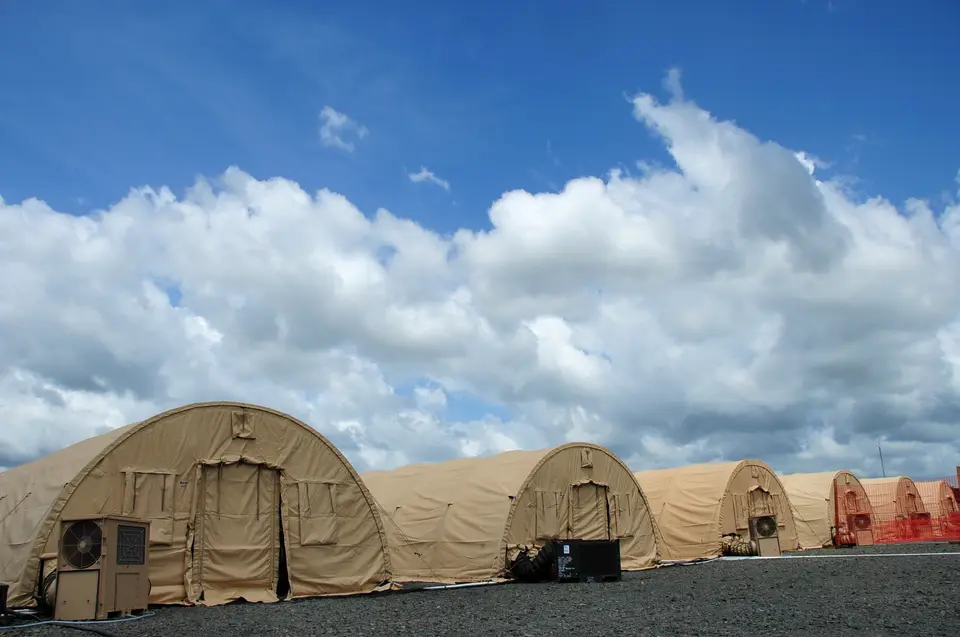
A Kenyan court has halted the American Ebola quarantine tent at Laikipia Air Base and ordered the deal disclosed. The tent is not a laboratory, but it is a window onto a map of foreign biology on African soil that no one was allowed to see.
By Adah Johnson · · 10 min read
There is a kind of philanthropy that arrives with boots on and a lease.
It is a good thing, we are told, that a tent was built inside a military air base.
On Thursday, a Kenyan court said what Parliament should have said months ago: the government breached the Constitution in the way it allowed a foreign power to build a 50-bed quarantine facility inside Laikipia Air Base, near Nanyuki, for that power's own citizens exposed to Ebola in the Democratic Republic of the Congo. Nothing more may be built there, and nothing may be operated, until the court certifies that the government has obeyed an order of mandamus (Latin for "we command") to disclose, within 45 days, the agreement, the assessments, the approvals and the protocols. Only then will the people who live around the base learn what was built in their name.
It took a judge, not a legislature, to say that, and the fact that it took a judge is where any honest account of Laikipia has to begin.
Read the judge's image and you hear the whole continent in it. Justice Patricia Nyaundi wrote that "the petitioners, the people of Kenya and more significantly, the residents of Laikipia County have been left with the position of persons standing outside the sealed wooden window, straining to discern what is taking place on the other side." They were aware, she said, that decisions affecting their community were being made and implemented, yet they had been denied any meaningful opportunity to know, interrogate or participate in those decisions.
How many Africans have stood at that window?
The official story was simple and noble, and therefore difficult to question. An outbreak of Bundibugyo Ebola, a strain with no approved vaccine or treatment, was spreading in Congo, and American aid workers were exposed to it. The United States, being prudent, declared through its Secretary of State, Marco Rubio, that it "cannot and will not allow any cases of Ebola to enter the United States," and instead of flying its people home, as it had done with its infected aid workers in 2014, it sent them to a third country. American military planners built a tented isolation unit inside a Kenyan air base, and more than thirty officers of the United States Public Health Service came to staff it, to hold the exposed in quarantine and to keep anyone who fell ill only until he could be evacuated to a high-level facility, "likely in Europe." Kenya, we were told, would receive $13.5 million for its own preparedness, and the unit was one piece of a $220 million American interagency effort. President William Ruto explained that had Kenya refused "one request by the Americans to set up a facility at their cost, we would look very inhuman."
And who wants to be the African who says no to help against Ebola?
That is how the language works: help is the word that makes questions sound ungrateful, and preparedness is the word that makes a quarantine for foreigners sound like a gift to the locals.
So let us be ungrateful, because the court has given us permission.
If this is for Kenyans, why, as the petitioners told the court, did Kenyans learn of it from Washington and the foreign press before Nairobi had said a word? If it is jointly run, why was it the American State Department that confirmed, in July, that seven American aid workers were already quarantined inside it while a court order barred its operation, and why did the Health Cabinet Secretary, Aden Duale, tell the Daily Nation to "ask Reuters"? Why did it take a finding of contempt against a Cabinet Secretary, in June, before the government told the court that work on the site had been halted? And why did three people have to die in the Nanyuki protests, among them Sylvester Muigai Ndung'u, a 17-year-old who, his mother says, had only gone out to collect his school uniform, before the state would accept that fear is also a form of knowledge?
And whose quarantine is it? In his affidavit the Cabinet Secretary swore that the facility was "not established for the exclusive benefit of foreign nationals," and he told Parliament that it was one of 23 similar units being built across the country. The Americans who built it, however, described a waiting room for their own citizens who were not permitted to go home, and Washington has not confirmed that Kenyans may use it. Both accounts cannot be the whole truth, so we are entitled to ask what its biosafety classification is, and where its environmental and social impact assessment and its safety contingency plan are to be found. According to the Katiba Institute, the petitioner whose name is the Swahili word for constitution, the documents the government did hand over contained neither the assessment nor the plan, and what remains in their place is not oversight but faith.
This is where the tent becomes more than a tent, because Laikipia is not alone.
No one can tell you how many American-funded biological sites exist on African soil. There is no public register, no international organization keeps a comprehensive one even for high-containment laboratories, and Washington, which pays for much of this work, has never published a list. That silence may not be a plot, but it is a convenience, and every convenience of this kind serves someone.
What can be counted begins with paper, and the legal umbrella under which Laikipia was built is a 2015 Threat Reduction Biological Engagement agreement between the United States Department of Defense, as the American executive agent, and Kenya's ministries of health, defence and interior. Parliament ratified it in 2017, and it was renewed in 2022 to run until 2029. Its stated purpose is to reduce threats from naturally occurring diseases and to secure collections of dangerous pathogens. It says nothing specific about quarantining foreign nationals, and whether Laikipia fits under it is exactly what the disclosure order must answer.
Under that umbrella and others like it, you find at least a dozen named sites across the continent. Some of them publish their research, but almost none have ever given the public a full account of what they hold, or of who decided they should be there, because almost no citizen was ever asked.
In Nairobi, the Walter Reed Army Institute of Research sits inside the Kenya Medical Research Institute (KEMRI), continuing a line of American military research in Kenya that dates to 1969, with clinical centres in Kericho and in Kombewa, in Kisumu County. In Uganda, the Makerere University Walter Reed Program holds a biorepository of more than 145,000 samples and 934,741 aliquots. In Accra, a United States Navy laboratory sits inside a Ghana Armed Forces facility, beside a liquid nitrogen plant that, according to the Navy, was first used in Sierra Leone during the 2014-15 Ebola outbreak to store and test suspected samples, and was later transferred to Accra. In Ethiopia, the United States Defense Threat Reduction Agency is funding a laboratory for the African Union's Pan-African Veterinary Vaccine Centre. In Gabon, it proposes to fund the decommissioning of a biosafety level 4 (BSL-4) laboratory and its consolidation into a biosafety level 3 (BSL-3) facility. In Morocco there is a pathogen consolidation unit, in Nigeria the securing of high-threat pathogen collections at two institutes, and in Djibouti a forward laboratory inside Camp Lemonnier. In Kisumu, a KEMRI collaboration with the Centers for Disease Control and Prevention (CDC) includes BSL-3 laboratories.
These are not all laboratories: some are clinics, some are surveillance sites, some are capacity-building projects. But together they form a geography of biology that was drawn without a public map. The question, then, is not whether a BSL-3 laboratory is legal in America, because it is, more than a thousand times over: the United States has roughly sixteen hundred BSL-3 laboratories and seventeen BSL-4 facilities, built or under construction, all operating under a system it wrote for itself. The question is who writes and enforces the rules when the same kind of work, or the same kind of risk, is placed in Kenya or Ghana, and whether the people living next door were ever asked.
The American government has answered part of that question itself. In May 2025, President Donald Trump signed an executive order complaining that federal money had paid for research "in China and other countries where there is limited United States oversight or reasonable expectation of biosafety enforcement." The order ended federal funding of dangerous gain-of-function research in countries of concern "or in other countries where there is not adequate oversight." That is an admission written in the language of a safeguard. It protects Americans from risks abroad, and it leaves unanswered the only question that matters here, which is who protects Africans from risks placed in Africa.
Meanwhile, the Pentagon's budget request would cut the Biological Threat Reduction Program (BTRP) from about $139 million this fiscal year to $66.5 million in 2027, citing "project cancellations in Africa," even as quarantine sites go up. The world cannot even agree on how many maximum-containment laboratories it has, counting 69 BSL-4 laboratories in 2023 and 110 in a 2025 study that also counted planned and deactivated sites, and that study found that 32 of the 34 African countries with at least one BSL-3 laboratory have no biosafety regulation or training. On that record we are being asked to trust, and it is fair to ask what, exactly, we are being asked to trust.
Trust that samples collected in Africa will benefit Africa? The umbrella agreement says only that the parties "shall agree" on access and benefit-sharing before cooperative research begins, and whatever they agreed is not in the public file. Several of the bilateral health agreements that Washington signed in 2025 with fourteen African countries (Kenya, Uganda, Nigeria and Rwanda among them), for sums running into billions of dollars, require governments to notify the United States of outbreaks within short timeframes and to share pathogen specimens. As Aggrey Aluso warned in SciDev.Net, once specimens leave a country, "there are few enforceable guarantees about how they will be used or whether originating countries will benefit from resulting products." We have been here before: during the West African Ebola epidemic, according to reporting by The Telegraph, hundreds of thousands of blood samples were collected and thousands were shipped out of the region, their whereabouts still unclear years later, and a British freedom-of-information request about them was refused.
Trust that this is not about power? Article Five of the 2015 agreement exempts American personnel and goods from "all taxes, duties, and levies," and Article Six bars the two governments from suing each other and says only that, on claims by third parties, they "shall consult." Article Eleven requires that disputes be settled "solely through consultation or negotiation," with no court and no arbitration. A resident of Nanyuki may still have whatever remedy Kenyan law allows him, but the treaty itself offers him nothing more than a promise that two governments will talk.
These are not small-print details; they are the shape of sovereignty.
It is worth being precise about what the court did not say. Justice Nyaundi stressed that her ruling did not challenge Kenya's cooperation with the United States or the government's power to respond to public health emergencies, and that restraint is exactly what gives the judgment its force, because the objection was never to help, only to help that could not bear to be seen. "Emergencies may demand urgency," she held, "but they do not suspend Constitutional obligations," and "Constitutional accountability is not satisfied by asking citizens to trust that all is well." That is true in Laikipia, and it is true in every other place where a building has gone up behind a fence for our own good.
So let us keep the questions that made a judge stand where Parliament would not.
How many such facilities are there on our continent, who owns the samples taken from our bodies, who owns the data drawn from them, and who pays if something leaks? Why did a quarantine camp for Americans cost, by a Reuters estimate, some $70 million, only to house seven people, while the Kenyans who actually fell ill with Ebola in October were cared for in Kenyan hospitals and tested in five Kenyan laboratories, two of them mobile units at border crossings? And why should a government that will not disclose an agreement about a tent expect to be trusted about a laboratory?
It is a good thing that a tent was stopped, but it would have been a better thing if it had not taken protests, three funerals and a contempt finding before a court would order that Kenyans be shown the paper.
The tent in Laikipia is not a laboratory, but it is a window, and for a moment the wood has come unstuck. We should look through it while we can, and count everything else that has been built on our soil while we were told not to look, because the next sealed window will also be called help.
Have an argument to make? Write for AfricaFrontPage ›