The Eye That Counts
The Interior Minister says TraffiTech recorded 13,699 infractions in its first week, almost four million cedis. The camera cannot be bribed. The person who owns the camera can choose what to point it at.
By Joseph A. Sampson · · 5 min read
There is a particular kind of smile that comes upon a man when he has discovered a new way of taxing his neighbours.
This week it was the Minister for the Interior's. At the end of the first week of TraffiTech-GH, Muntaka Mohammed-Mubarak told us 13,699 infractions had been recorded (almost four million cedis). In one week. Road accidents, he said, started to go down immediately.
You could hear the satisfaction in the figures. Four million in seven days. The language was very careful indeed (infractions were recorded) as if the camera did it all by itself, as if no human had any choice in sending the bill. Passive voice is always the safer option.
Let us look at what we are told and what we are not told.
What we are told is that 13,699 infractions were recorded. That is 81 an hour. The camera does not sleep, it does not go on leave, it does not accept a folded note from a driver. In that respect it is progress. Anyone who has ever driven past an officer of the Motor Traffic and Transport Department (MTTD) will know what the old system was like: a negotiation on the spot, a hundred cedis changing hands, no receipt at all. The camera ends that. It cannot be bribed. That is a good thing and any honest driver will agree with that.
All fines are not equal but all bribes are cheaper than fines. The MTTD officer wanted 50 cedis for himself. The camera wanted, on average, 292 cedis for the state. The driver who used to pay the small bit of corruption is now being asked to pay the big official one. That is what the state calls reform. That is what the driver calls an increase.
And that is the first question you have to ask right at the outset, because political language is designed to make theft sound like efficiency. Is this about safety or is it about revenue?
Four million a week is more than seventeen million a month. Just over two hundred million a year. That is more than the Ministry of Labour, Jobs and Employment was allocated for the whole of 2026: 142 million cedis. When a government comes across a machine which can print money out of the habits of its own people it almost invariably does not switch it off. The temptation is to let the bad driving go on, because the bad driving pays. A government which has to rely on traffic offences to keep the books in balance has a vested interest in the bad driving continuing.
The second one is actually simpler and rather awkward: whose cars were caught?
13,699 infractions. In Accra where every junction has a V8 with a flashing light that does not stop. Where the police dispatch riders will clear the way for a man who is running late for a meeting about punctuality. Where a siren means "I am more important than you".
Were any of them in the 13,699? Did the system pick up a minister's Land Cruiser at 120 in a 50 zone? Did it pick up a police car without a number plate? Did it pick up the same black Toyota doing 100 past Kawukudi every morning?
If it did, publish the plates. If it did not, explain why. A law which only catches trotro drivers and private cars is not a law at all. It is a net for the small fish with holes cut in it for the big ones. Nothing is more corrosive than having equality on paper and exemption on the road.
The third question is the one we are not meant to ask. A camera that can catch a speeding car can see everything else. Running a red light is already among the forty-nine offences in the new law; they have only started with one.
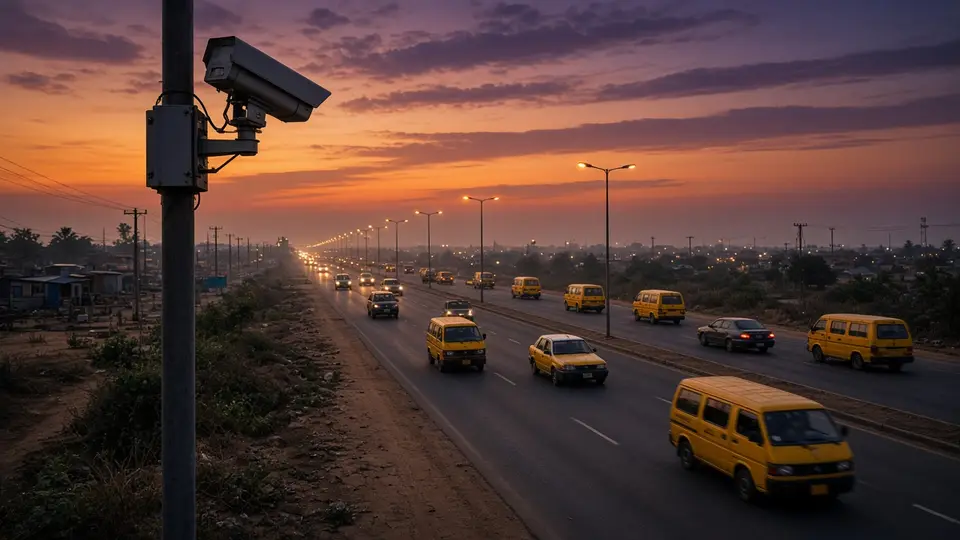
We are told it is for traffic. Today it is for recording infractions, and we are told it will reduce accidents. A camera on a major road, recording every number plate, every hour, is not a traffic device. It is a register of movement. It will know who went to which church, which hospital, which opposition meeting and at what time.
As Orwell had it, he who controls the past controls the future, and he who controls the cameras controls the past. The footage is stored somewhere. The Road Traffic (Amendment) Act, 2025 (Act 1153) and the Road Traffic Regulations, 2026 (Legislative Instrument 2519) were enough to switch the cameras on and send the bills. What they do not say, in any published rule, is how long the footage is kept, who may search the wider record, or that it cannot be used for anything other than traffic. All we have been told is how much money it made.
And yet, if we are to be honest and give both sides of the story, the minister tells us the camera has done in one week what a decade of sermons and billboards could not do. Accidents, he said, went down immediately. Not after education. Not after a campaign. Immediately.
We should ask for the numbers before we applaud. He gave us the fines down to the last infraction, but for the accidents he gave us only an adjective. How many crashes were there in the first week of November, and how many in the same week last year? How many deaths? One week is not a trend; it is a rumour with a press release. The Motor Traffic and Transport Department itself reported that crashes had already fallen by 9.4 per cent in September, before a single fine was issued, and the President has said the month-by-month comparison is still to come. A minister who can count every cedi he collected should be able to count every life he claims to have saved. Until he does, the decline is a claim, and the revenue is a fact.
If the decline is real, it will be because people will not obey the law when they are asked to. They will obey when they know they are being watched. The eye in the sky is more effective than the conscience in the heart.
So we are left with the deal that all modern states offer: surrender a little freedom in return for a little safety. We will watch you and we will stop you killing each other on the N1. It could be worth making. The MTTD bribe is over. The big man may finally have to back off. The lad who walks across the road to school may well live. But let us not pretend it is free.
Every time we put in a camera we are adding a little more to the police state, even if the policeman is now a computer. A government that makes a profit from its citizens' misdemeanours should be asked whether it really wants those misdemeanours to stop.
The camera does not lie. The person who owns the camera can choose what to point it at.
Have an argument to make? Write for AfricaFrontPage ›